Middle School Can Be Toxic!

Like many other moms of girls, I found out that our middle school was a very toxic environment. Even more so for the emotionally fragile. Unlike my son who had basically sailed through his middle school years with his same buddies from elementary school and who came over on weekends and played D&D. My girls entered the snake pit of middle school having no idea what was in store for them.

While they both started 6th grade with excitement of starting off a new school and a fresh start from the pain of middle school. Unfortunately, the happiness was short-lived because after a couple of weeks both girls starting having difficulties attending school. C was the first to show signs of the trouble to come. She began having terrible stomach aches in the morning; she faked throwing up (she would mix a bit of oatmeal in a bowl and spill it into the toilet–I got wise when the “vomit” smelled like strawberries & cream.) She came up with lots of excuses, she missed the bus and I would have to drive her. Then S started also having problems going. I don’t know if they were necessarily feeding off each other — but it was a chicken and egg debate. It didn’t really matter. They both struggled and were in pain.

Unfortunately, their troubles were exacerbated by the fact that they didn’t feel a part of the school community. They felt the odds ones out because how can a child make friends and make connections when they are unable to stay in school long enough to do so. In addition to the stigma of being “weird” or awkward or “abnormal”. Adolescence is painful enough even without emotional handicaps. They were late; and missed the social aspect of the mornings; they were absent and missed events and were no longer in the social loop. They didn’t get invited to anything because my girls were troubled and parents didn’t want to be involved. It was a vicious cycle and it was all so sad.

C had several panic attacks in school; a few times she locked herself in the bathroom and threatened to hurt herself. I got called often to come get her or I was asked to come to defuse the situation. Many times I was just as clueless as they were about what to do. So the crux of the problem wasn’t my girls ;it was where or who can you turn to when the place that you believe has all the answers for educating your children has absolutely no idea what to do? The school counselor insisted that they had no prior experience with children who refused school, like mine. Apparently we were the first! They scratched their heads as they tried to figure out what to do to “help”. So their brilliant solution was to call DCF (Department of Children and Families) because of “educational neglect” and we were reported for truancy. This way they could wash their hands of us and make us someone else’s problem. At this point, I think the school wanted to be done with us.

I feel I need to stress the fact that that both girls were being treated. They were on medication and receiving therapy. We had been working with mental health care providers for a number of years already. We were doing everything possible to be best of our ability.

A couple of months after middle school started, C had her second episode of “eloping” (which is a fancy word for leaving the school building without permission.) The first one was mild and she only got to the side parking lot before staff noticed and police were called. The second time she had walked almost a mile from the school to the McDonalds close to our house. That was where the police found her after they reported her missing. I was away that morning visiting a friend in a hospital in Westchester when my cell phone rang. When I saw the school’s phone number on my cell, I took a deep breath. What was it now? What happened that I would have to drop everything for. I didn’t expect them to ask if C was with me. “What? What do you mean? She’s at school!” How would I have been able to take her out of school without them noticing? It was a ridiculous question. I was told that apparently she had been missing from the school for quite a while before they noticed. I was about 45 minutes away and I drove like a bat-out-of hell to get to the school to find out what happened. I imagined so many different disastrous scenarios. I have never been so scared in my life. By the time I arrived at the school the police had found her. They located her at the McDonalds near our house, calmly refilling her water bottle. She wasn’t in distress; she wasn’t upset. She explained to the police that she left because she wanted to come home. So between classes, she walked out the door and left the building. After we were done with the police and school was informed of the outcome, we went home. I honestly don’t remember if I met them at the school or at the McDonalds — details are a little fuzzy.

I hope it goes without saying that we had a serious conversation with C telling her that she must never, never do anything like that again. She had scared all of us half to death. Not only did she break the school rules; she put herself in grave danger. We were firm but calm with her. We didn’t yell or shout because really, what else could we do? My emotionally fragile girl was acting out of self-preservation. She was anxious at school and wanted to be home with her mom where she felt safe.

The second elopement incident was a wake up call for the district that something had to be done and they acted immediately. A PPT meeting was called within a couple of days to determine that the current school placement was not in C’s best interests. They decided she would attend a therapeutic day school in a neighboring town. It had a smaller student body and a higher teacher to student ratio. There were counselors available, and they were equipped to deal with an anxious 6th grader. Most importantly, the front door was locked.

C did well there. It was not an ideal place, and we later came to have issues with it, but it was better than the toxic place she came from. She started to do better in school and attended more regularly. I believed, and still do, that this placement was mostly done as a CYA (cover your ass) by the district. They could not afford to have C leave the building again; what if her next elopement ended in tragedy?

And so our journey to the previously undiscovered land of out-of-district placements began. The path was winding and circuitous but it ultimately brought our daughter back to a mainstream school and much success (she is a college freshman this year). Before, we hadn’t known that there were other options available for those for whom mainstream schools are not a good fit. Students who learn differently; have developmental delays or challenges and those who are not strong emotionally to handle the stress and responsibilities that school requires of them. Because the state has a legal and moral obligation to provide your child with an education in the least restrictive environment possible, you have choices in what school they attend; you have a say in where they are placed. There may be a schools which may have an opening, but you feel that it’s not a good fit or you or your child have a negative gut-reaction. You have ask if there is an alternative? To be honest, you may not have a choice. Sometimes timing is against you and you are forced into a situation due to availability. We had such a situation with our other daughter S, (that’s another story). So what I want to convey is that just because the district holds the purse strings, you still have a say and input into where your child is placed. You are not powerless.


Photo by Micah Boerma on Pexels.com
Standard

“I’m From the Government and I’m Here to Help” NOT!

In elementary school both my girls struggled with anxiety and attending school was a big issue. There were days in which I wasn’t able to get them on the bus, they refused to get up out of bed at all. There were many mornings of begging and pleading and negotiating to get them to go, some mornings more successful than others. I could never relate to parents whose children were excited and happy to go on the bus to school! Many of my friends couldn’t understand why my children didn’t get up and go to school. “What do you mean you can’t get them up? Make them get up!” they’d say. I felt alone and isolated because I got the impression that I was the only parent who had issues like that. On reflection, I think I’m the only one who was willing to share my difficulties.

Some days C would have a panic attack as we walked into the school. She would try to leave with me, or she would cling to me at the classroom door begging me to take her home. Other days, S would have trouble waking up or getting on the bus. Sometimes they took turns. Sometimes it was both of them at the same time. It was painful and stressful for the whole family—I really had no where to turn.

The school offered no real assistance, I shuddered when I saw the school number on my phone during the day, because it invariably meant I needed to go pick up one of the girls. I sometimes argued with them about having to pick them up—telling them that if I pick them up every time they cry that they want to come home; isn’t that giving them exactly what they want? Isn’t it feeding into that behavior? Can’t the school do anything? No—I was told. That was not their responsibility. So it became a cycle of behavior that I didn’t know how to break.

The girls, individually and together, missed so much school that DCF (Department of Children and Families) was called in because Educational Neglect was reported by the district. We were assigned case workers who either didn’t have children and/or had no experience with mental health issues. DCF came at the problem as a parenting issue, the message being that we are bad parents and that’s why our girls don’t go to school. So I was sent to parenting classes (my husband was too). We were told the parenting classes were “optional” but really? Can you say no to a suggestion from DCF? I didn’t think so. So I went to 8-10 hour long parenting classes taught me about the importance of nutrition; avoidance of drugs and alcohol in the home; don’t have guns and weapons inside the home, etc. No one seemed to take into account that we were already parents of another child who didn’t have these issues–we weren’t clueless new parents.

So the reports of truancy and Educational Neglect continued well into middle school. We kept trying our best, and we kept getting support services in the home, (IICAPS) after school (Prospects). At one point, the girls and I were called to be in front of the Truancy Review Board. The girls were about 8 or 9 at the time. We were called into a large conference room. In front of us was a row of personnel involved in truancy. There was an assistant vice principal of a local school, two psychologists, two police officers and a couple of others. I was asked questions and asked to defend myself and explain why my children didn’t attend school. I explained that my girls were anxious, that they refused to get up! What was I supposed to do? Was I supposed to throw them over my shoulder and toss them into my car? My girls even spoke up for me and said it was them that couldn’t get up. They were very brave to speak up. After a short time, the assistant principal spoke to me and declared, “if you were in my school district; I would bring you up on charges!” I was stunned, shocked and afraid.

None of the government agencies helped us, helped my girls, because they hadn’t yet addressed the root of the problem which was my girls weren’t able to attend a large public school due to anxiety issues. They both needed smaller therapeutic schools to ensure that they got the education they’re entitled to. Unfortunately, it would be a few more years before that would happen.

Stay tuned…..

Photo by Kat Jayne on Pexels.com
Standard

“I Can’t Read My Own Handwriting!”

Because of my son’s speech delay he also struggled to write (same muscle family) So one part of his IEP (Individual Educational Plan) was occupational therapy (OT) in order to strengthen his hands and fingers. He had been making progress but after a couple of years, the district inexplicably determined that he no longer needed it. But his handwriting was still basically illegible! The district’s decision to cease services was unwarranted, so we called for a Planning and Placement (PPT) meeting to address our concerns and asking for them to reinstate his OT services.

For those unfamiliar with special education services; each atudent has a document called an IEP (Individualized Education Plan). An IEP is exactly as it’s named. Children are unique and each has their own requirements for what will allow them to learn. Accommodations can mean extra time for tests for those with ADD/ADHD or executive functioning deficit, large print and/or Braille texts for students who are visually impaired. There are many types of services that can be provided, these are just a few. However, many school districts would rather refuse services than provide them.

There’s an interesting article in the New York Times from 2005 (a link is below) which addresses how contentious the issue became with parents and schools. Instead of partnering together to ensure an education. Parents and districts were going to court to fight over it.

We called a PPT meeting (parents have the right to call for one; anytime). We wanted to them to explain to us why they wanted to stop the OT. After a lot of blah-blah-blah, the highlight of the meeting was when we were told that handwriting isn’t critical to students because, according to her, “everybody uses a keyboard nowadays.”

She said that with a straight face.

We countered, “what about forms? Job applications?” They just waved our concerns away but when our son was asked to speak on his own behalf, he told the room that “I can’t read my own handwriting, I can’t read the notes I take for class.”

That stopped them cold. They reinstated the OT.

The point of this story is that your child has a right to an education and the state is obligated to provide it. You have rights, you have a say, and you have choices. There are many resources at your disposal, so take advantage of them so that you can be an informed advocate for your child. The most important thing is that you accept your child’s differences and love them unconditionally. For all the challenges I’ve faced as a parent—I wouldn’t change a thing about my children.

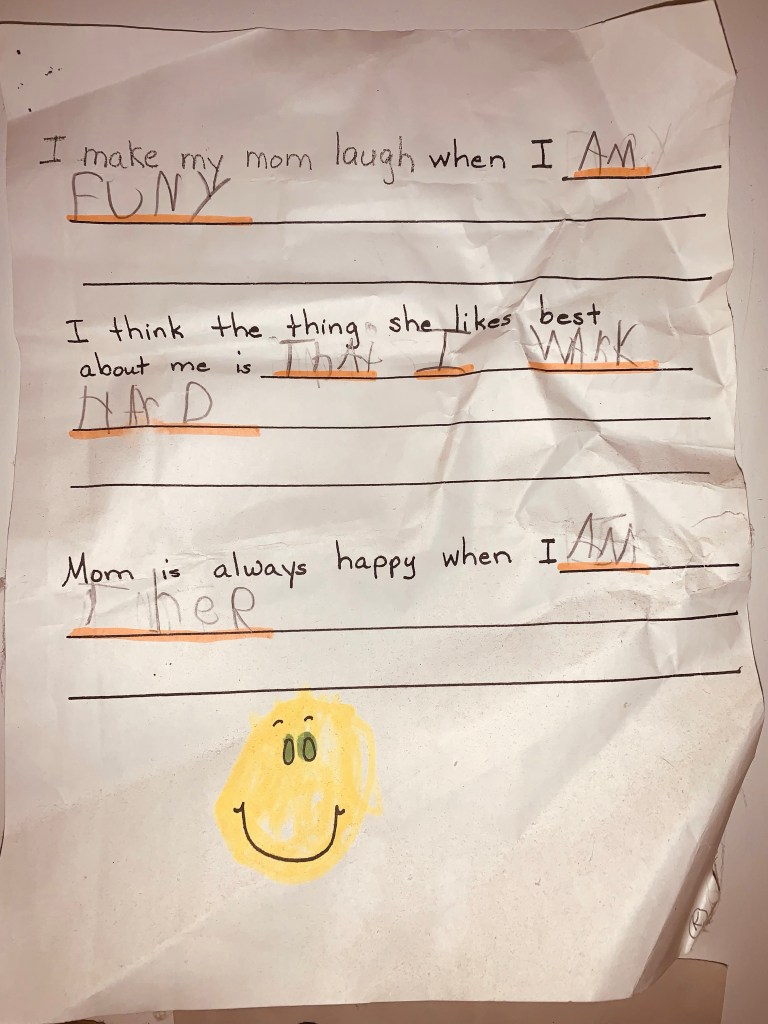
“I made my mom laugh when: I am funny,
I think the thing she likes best about me is:
I work hard; My mom is always happy when: I am there”

Continue reading
Standard

2 for 2!

I knew I was having twins from the beginning of my pregnancy. I had undergone fertility treatments after multiple miscarriages and a stillborn daughter conceived naturally.

We had tried and failed to get pregnant with my eggs; but due to my age—it wasn’t happening. We had briefly considered adoption, but I couldn’t do it. I needed to prove to myself that I could have a baby. A baby that lived. I needed “vindication.” After all, the baby had died inside ME. I felt responsible and guilty. In order to heal, I was convinced that I needed to feel life inside me again. I needed to give birth successfully for my redemption. While adoption is a great choice for some, it wasn’t for me.

After Emily died, we didn’t do an autopsy, what would be the point? It wouldn’t have made any difference, but they thought it was because the umbilical cord was wrapped around her neck. Who knows? I also tested positive for Lyme disease which I found out later causes miscarriages. I didn’t know I had it! Fortunately, I got treatment and recovered fully from the Lyme disease, but not my broken heart.

So after I healed physically, we decided that IVF (in-Vitro Fertilization) with a donor egg was the route we were going to take. We were given a packet of potential donors for us to choose from. It was kinda like dating. We ultimately chose a young woman (34 -about 10 years younger than I at the time) who already had children. When I read her profile; I knew she was the one! She was short, had curly hair and wore glasses. She was crafty, just like me! So an agreement was made; we would contract with her for her eggs. She would relinquish all parental rights to whatever offspring that may be produced. She underwent the super ovulation procedure and produced 4 eggs. (The same number that I had popped; but hers were younger). The fertilization was done in a lab, and a couple of days later I got a call. The eggs were ready for implantation! They fertilized four; 3 took but only 2 looked good enough for implantation.

After the procedure, I had to stay on bed rest until the we got pregnancy test results back. It was a very long couple of days! Then the phone rang and I got the amazing news that I was pregnant with twins! My husband and I both cried when I told him the news!

Now the waiting-and-praying time began. Would I stay pregnant? The first hurdle was the 10 week mark, when you can usually see the heartbeat on ultrasound. A couple of my pregnancies were found to have ended when this milestone wasn’t reached.

But it went fine! Two healthy heartbeats. I was under careful supervision because I was considered high risk because of my age and my previous stillbirth, I went into my doctor’s office once a week and then later twice a week; for heart-rate stress tests and lots of ultrasounds too. Coincidentally, my doctors office was shopping around for a new ultrasound machine. So Baby A, Baby B and I were the road test subjects. I didn’t mind. It was interesting and I got some awesome ultrasound photos for my scrapbook.

And so the pregnancy continued. I was healthy, but I got HUGE! I followed doctors orders to take care of myself. I also prayed a lot! I asked for lots of prayers because I believe in the power of prayer.

You might think I would be super paranoid about my activity level while pregnant the twins. I really wasn’t. I decided to act on faith that it wouldn’t happen again. Besides, I had an 8 year old to take care of. I also knew that being stressed wouldn’t help us. So I relied on my faith and expert medical care. I also received lots of love and support from my husband, my son and my friends and family brought me to the delivery room at 38 weeks. I just read that only about 6% of woman my age carried IVF pregnancy to term.

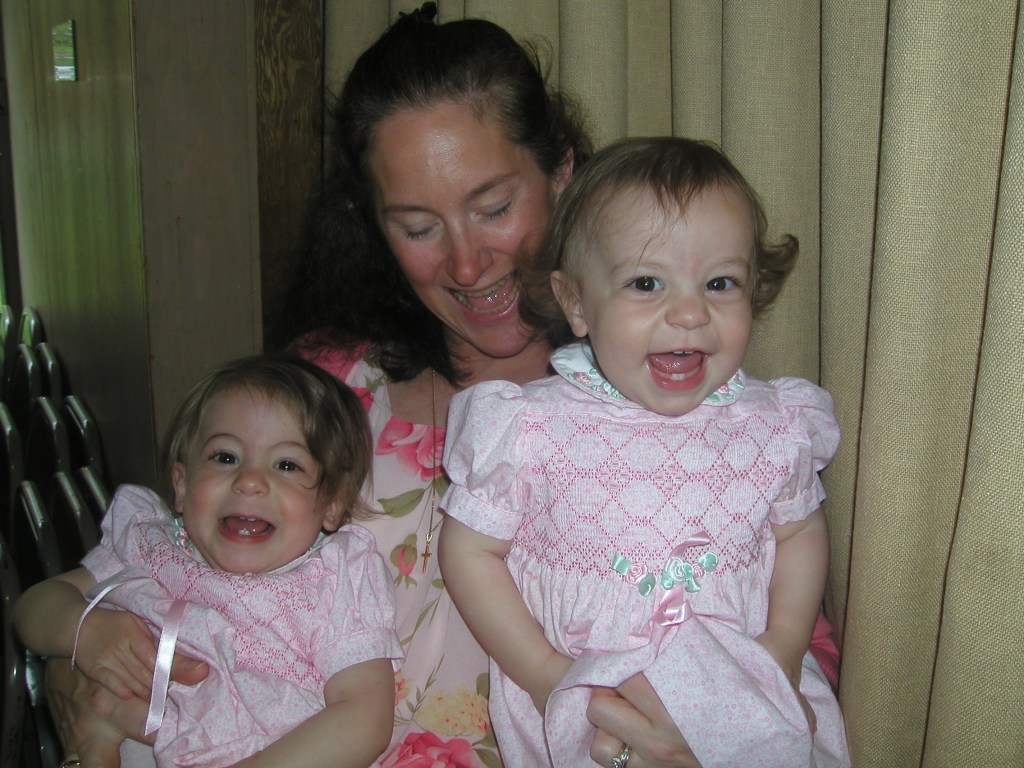
So a miracle followed a tragedy. Here are my miracles!

Mother’s Day with C&S as a mother of 3

https://www.pennmedicine.org/updates/blogs/fertility-blog/2018/march/ivf-by-the-numbers

https://www.marchofdimes.org/complications/lyme-disease-and-

https://www.webmd.com/infertility-and-reproduction/guide/donor-eggs-in-fertility-treatments

Standard

“Make it Night, Mommy!!”

I was blessed with twin girls who were born when my son was 8 1/2. After many miscarriages, a stillborn daughter at 38 weeks, and many fertility treatments; I delivered beautiful, very healthy, full-term girls. The girls grew and developed at a normal pace. They walked at around 15 months and started talking at around 18 months. As a precaution, I had them both evaluated by Connecticut’s Birth to Three System. As I expected, they met all goals and benchmarks that they were tested for, but I needed to be sure.

At an early age, I noticed that one of my twins “S”, was very rigid and inflexible in many ways. She insisted on wearing her favorite footed pajamas almost every day, and wore them even when she outgrew them and her toes poked through the bottoms. I sewed them back together when she became inconsolable because they had holes in them. She was about 3 at the time, but she wore them for another 6 months.

One night when the girls were 3 or 4, I was going out to a church-lady evening (as I called them) and would be back after the girls were asleep. S was not happy that I was going out and wanted me to stay and read stories. So I promised her that if she was still awake when I got home, I would make hot chocolate and we would read together. I returned about 9:00 p.m. and went in to check the girls and as I thought, they were asleep. I kissed them on the head and went to bed myself.

The next morning, I went into the girls’ room to wake them up. When S woke up she said, “where’s my hot chocolate?” She looked outside the window and saw that it was daytime, and with panic in her eyes; she repeated, “Mommy, where’s my hot chocolate?” I explained that when I got home it was late and she and her sister were asleep, so I didn’t wake her. So I offered to make her morning hot chocolate instead. S was not having that, “No! Mommy, make it night again! Make it night again!” She wept in my arms. She didn’t understand that I couldn’t do that. I wonder if she thought that I was unwilling, not unable.

That was one of the first indicators that something was not quite right, emotionally speaking. She was only 3, and already showing signs of the anxiety which would keep her in a few short years from attending school. It marked the beginning of a long and painful journey, one that we are still navigating through. I hope that through this blog I can offer some words of support and encouragement to those who are just starting on this path. For many years, I believed that I was the only mom and we were the only family, who were having similar struggles with their children. I learned that I was wrong, but I wouldn’t learn that for a very long time.

Photo by Bruno Scramgnon on Pexels.com

http://birth23

Standard

The Great Non-Communicator

My first child, a boy, was born at a very healthy 10lbs 10oz. He was HUGE! He was the buzz of the hospital nursery. The nurses would laugh and say, “Oh, you’re the mom of the BIG baby!? We had to get diapers from the pediatric floor, because he doesn’t fit in the newborn ones!” So despite the fact that he came home wearing size 3-month clothing, he had a normal babyhood. Until at around 18 months, while playing with some playmates I realized that my son wasn’t saying words like the other boys. They said “mommy, more goose (juice)” and many other simple phrases and words. My son? Nope…sounds, grunts, pointing and showing me what he was talking about. It worked for me! My son did get very frustrated and banged his head sometimes but I still hadn’t quite realized this was a problem Fortunately for me, one of the moms decided to speak to me about her concerns. She suggested that I have him evaluated by Connecticut’s Birth to Three System. Birth to Three’s “mission is to strengthen the capacity of families to meet the developmental and health-related needs of their infants and toddlers.” I was told that they had specialists who would come into my home to evaluate my son for possible speech delay issues. Was I grateful for this kind and caring advice? NO! I was not! Like many new mothers, I was insulted and hurt because I took it personally. I was too insecure to take well meaning advice. It seemed to confirm my own worst fears; I’m a bad mom! I have no idea what I’m doing! I told myself lots of BS. He’s only 2 1/2! He’ll wake up tomorrow morning and say “Good Morning Mother!” in a clipped British accent! Or recite the Gettysburg Address at the dinner table!

Of course, I was in the river in Egypt: Denial!

After I had a week or two to calm down and think about it, I realized that she was absolutely right. No one but me (and sometimes his Dad) could understand him. He got frustrated when I didn’t understand and he couldn’t tell me what he needed or wanted! Poor guy! One morning I was in my room and I heard a quiet thunk,thunk,thunk coming up from the stairs. What was it? It was my son hauling up a gallon of milk step-by-step to show me he wanted a cup of milk. Did I mention how strong he was?

So a short time later, I got over myself and called Birth to Three. They listened to my concerns about my son and his lack of words and sounds. Two lovely therapists came out to my house a week later and spent qitesome time evaluating him. They asked about family history, my pregnancy, labor and delivery and so forth. They were kind and gentle and professional. After reviewing their findings, they determined that he did have Expressive Speech Delay–which is different (and easier to treat) than Receptive Speech Delay (which involves the brain receptors which interpret the spoken word and sounds) . My son had no problem with that, he was able to follow 2 step commands like “take your shoes off and put them by the door.”

Expressive delay is usually due to a deficit/weakening of the fine-motor muscles. So while my son could understand instructions, he couldn’t repeat them. I hadn’t realized that the tongue is a large muscle which is in charge in the formation of sounds; words and sounds. Birth to Three would provide services to our family, and our son was to attend pre-school at the STAR Rubino Center in Norwalk. Their primary focus was to work with children with speech-delay; speech impediments; mutism. I turns out that instead of being a bad mom, I was being too good a mother. I was the interpreter for my son. I understood his “words” and his approximations of language;

The Rubino Center was an answer to prayers. He spent 2 hours, twice a week in the classroom, and he saw an individual speech therapist as well. The goal was to strengthen his tongue and lips. Unlike other kids, he had a fun homework assignment; he had to drink a McDonalds milkshake every couple of days. While it’s not necessarily a healthy choice, but that think liquid going up the straw sure gave his mouth a workout! And a good incentive too!

I think his first word that I understood was “puddle” which he told me after class following a rainstorm. It was my favorite word for a long time.

A few years later, I ran into the mom who had suggested that I have my son evaluated; I apologized for my initial response to her and thanked her warmly for her help in pushing me in the right direction to get him the speech therapy he needed. I described the progress he had made thus far and that I would have waiting much longer had she not intervened. It also helped me realize that the biggest impediment to getting him help was ME! My own ego and my own insecurities, which should have been put aside.

Photo by Crystal Partridge on Pexels.com

http://www.birth23.org

http://www.starct.org

Standard

I can’t be having a boy!

I got pregnant about 1 year after I got married, which I didn’t expect. I had heard that trying to get pregnant at 30+ was difficult. For me? Not so much. Once I found out I was pregnant; I was ecstatic! So I had my multi-vitamins, had lots of rest. Ate lots of McDonalds French fries and chocolate. It was lots of fun—until at one of my early checkups, the 90 lbs doctor at the practice told me that I was putting on weight! That was the last time I saw her—Nobody gets in the way of my fries and chocolate!

Later in my pregnancy; at about 7 months, almost every woman I met looked at me up and down and questioned, “You’re having a boy, right?” Or made a declaration, “You’re having a boy! I can tell because you are round; you are oval, the baby is high, the baby is low” and so on. Everyone I heard that I went into panic/denial mode. “Oh no, no, no, I’m not! I told them. Thinking to myself; I can’t have a boy! I don’t know anything about boys! I know Barbies, paper dolls, coloring books, dress up, baking cookies, etc. All the girlie things of the 1960s. I had no experience with boys! So imagine my reaction when in the delivery room, the doctor announced in the opening room that “it’s a…..BOY!”

I almost asked the doctor to repeat himself, just to be sure.

Of course, the minute he was put into my arms; it didn’t matter what my baby was. My baby was healthy and beautiful and I loved him. And that’s all that mattered. I would figure the rest out later.

Standard

In the beginning…

I grew up in NYC in the 1960s as an only child of a divorced mom. My mom worked 3 jobs at one point to keep me in school. I don’t think my father contributed much, if anything. I was an only child—and most of my school friends were also onlies and/or had divorced parents. My mom wasn’t social, so it amazes me how many kids were in the same boat as I. So I didn’t have a lot of experience with usual family dynamics. My aunt and uncle had 4 kids; 3 boys followed by a girl. They lived overseas when they were young, so they came into my life when I was about 8 or 9. I used to visit on weekends, there was lots of things going on and lots of loud voices and yelling—I always thought they were angry! I’d had no experience with sibling rivalry or jealousy or competition.

So when I got married in my mid-thirties, we had already decided that we were going to have more than 1 child (he said 3, I said 2: he won) because I didn’t want my children to have the only child dynamic. (I married an only too).

So despite having no experience with siblings; I made them.

Standard